KH
KH  FR
FR  AR
AR CN
CNCambodia Steps Up Regional Leadership on Animal Disease Prevention
AKP Phnom Penh, April 20, 2026 --
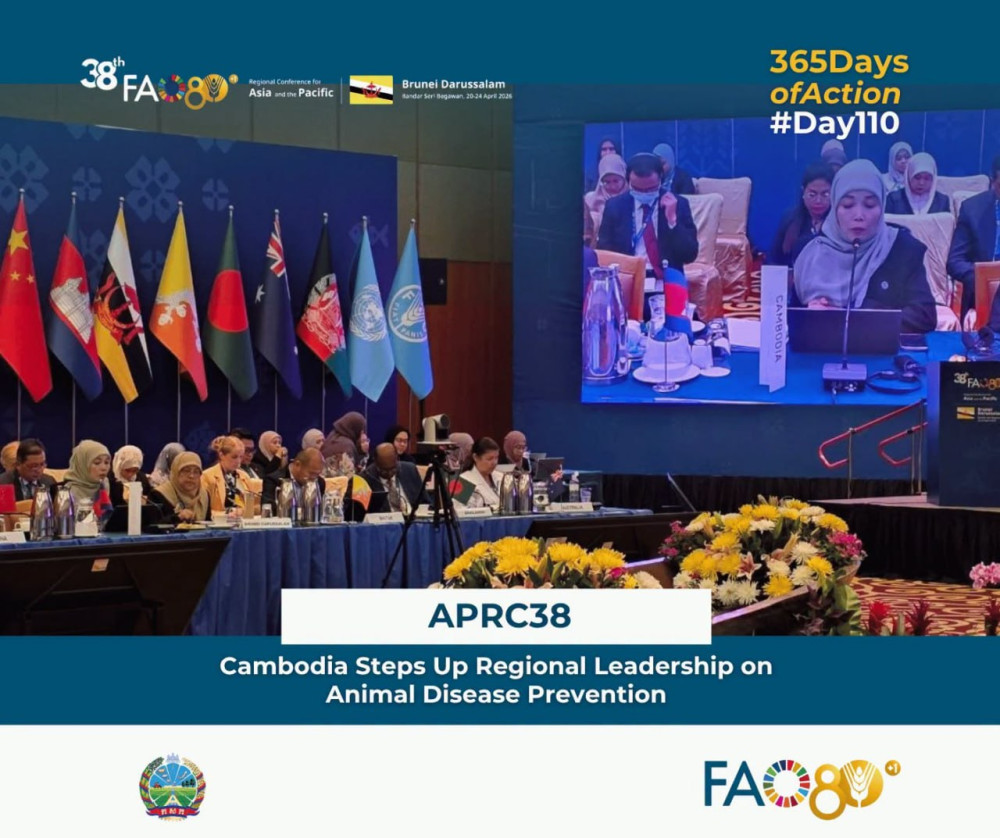
Cambodian delegation, led by H.E. Ms. Yoeu Asikin, Under Secretary of State, Ministry of Agriculture, Forestry and Fisheries, represented the country at the Opening of the Senior Officers Meeting (SOM) of 38th Session of the FAO Regional Conference for Asia and the Pacific, held on April 20 in Brunei Darussalam.
In her statement, H.E. Ms. Yoeu Asikin highlighted Cambodia’s commitment to transforming its agrifood systems to be more resilient, inclusive, and sustainable, according to a FAO statement issued on April 20.
Cambodia recognises that Transboundary Animal Diseases (TADs) remain a major threat to food security, livelihoods, and public health across the region.
In line with the “Five Bold Actions for One Health” outlined by Samdech Moha Borvor Thipadei Hun Manet at the recent OneHealth Summit in Lyon, Cambodia is ready to move from a national success story to a regional strategic leader.
Building on 21 years of partnership with FAO-ECTAD, supported by the United States, the Pandemic Fund, and other partners, strong technical capacity and institutional experience have been developed in Cambodia.
Cambodia is now formally proposing to become a Regional Hub for GPP-TAD for the Greater Southern Mekong Epizone—serving as a centre for surveillance, diagnostics, and coordinated response to high-impact diseases like avian influenza (HPAI) and African Swine Fever.
To turn this vision into action, Cambodia proposes four key initiative such as: 1. Establish a regional cross-border data-sharing platform to strengthen early warning systems—so that a threat detected in one country is quickly shared across all.
2. Pilot a public-private partnership (PPP) model under GPP-TAD, using blended finance to support regional biosecurity and develop “disease-free trade corridors.”
3. Expand efforts to include environmental surveillance, with research on how climate changes—such as Mekong water levels and migratory bird patterns—affect disease transmission.
4. Set up a Mekong Veterinary Epidemiology Training Centre, building on Cambodia’s CAVET programme to strengthen skills and capacity across the region.
To support this role, Cambodia is calling for FAO assistance in two areas including upgrading the National Agricultural Laboratory (NALS) to international reference laboratory status for priority diseases and introducing real-time, cloud-based tools for local agriculture officers to ensure faster, connected disease surveillance from community to regional level.
Cambodia is ready to lead a coordinated regional response to animal disease threats—turning national progress into stronger regional resilience and global health security.
By Chea Vannak