KH
KH  FR
FR  AR
AR CN
CNCambodia Rejects Thai Delegate’s Remarks at 153rd IPU Assembly
AKP Phnom Penh, October 11, 2026 --
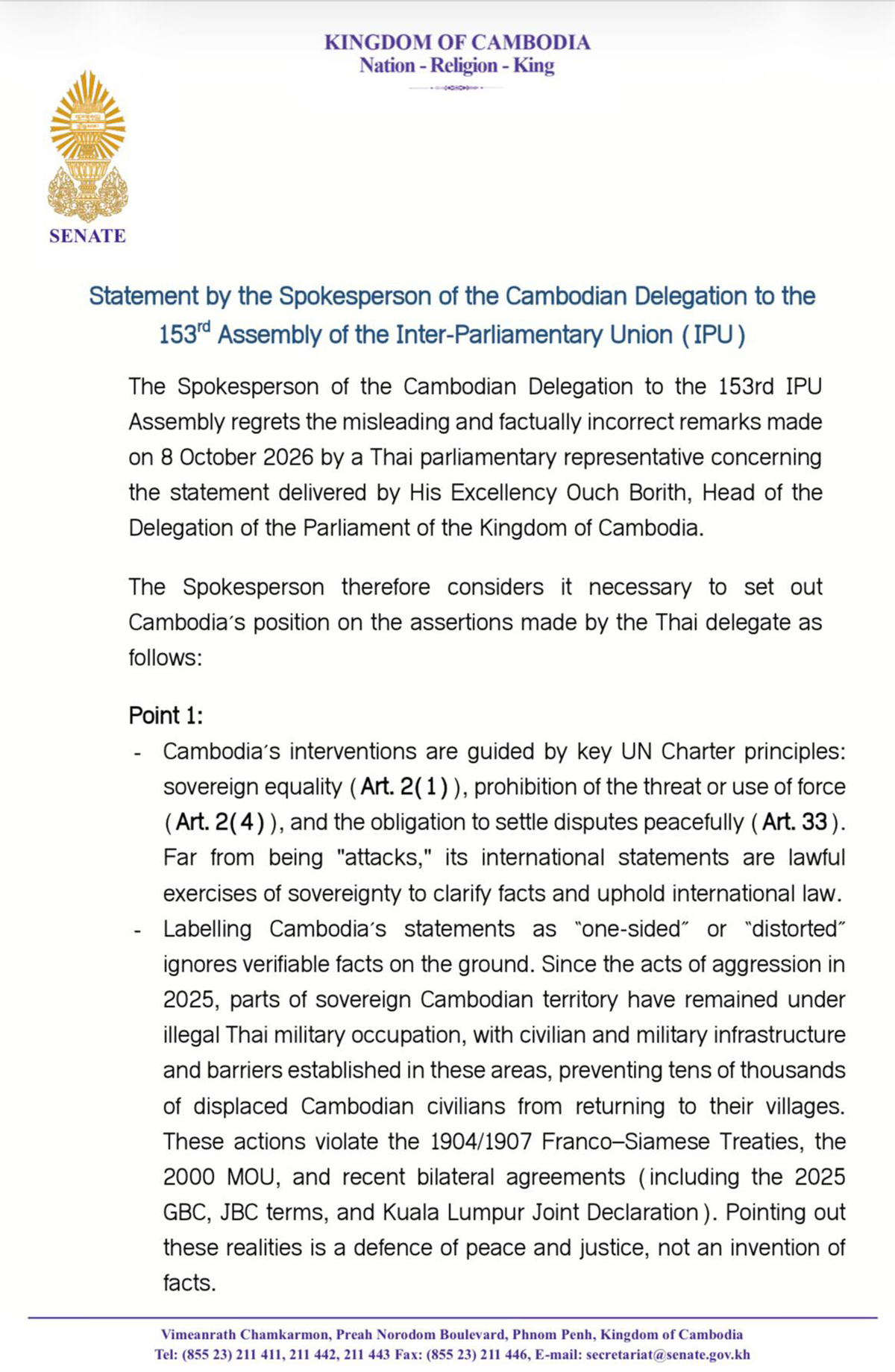
The spokesperson of the Cambodian delegation to the 153rd Assembly of the Inter-Parliamentary Union (IPU) has rejected the misleading and factually incorrect remarks made by a Thai parliamentary representative on Oct. 8 concerning a statement delivered by H.E. Ouch Borith, Head of the Cambodian Parliamentary Delegation.
In a statement dated Oct. 10, the spokesperson reaffirmed that Cambodia’s interventions in international forums are guided by the principles of the United Nations Charter, including the sovereign equality of states, the prohibition of the threat or use of force, and the peaceful settlement of disputes. The spokesperson said Cambodia’s statements were legitimate exercises of sovereignty aimed at clarifying facts and upholding international law.
The statement also maintained that parts of Cambodian territory remained under Thai military occupation following the 2025 hostilities, with barriers and civilian and military infrastructure established in the areas, preventing tens of thousands of displaced Cambodian civilians from returning to their villages. It said these actions violated the 1904 and 1907 Franco-Siamese treaties, the 2000 Memorandum of Understanding, and subsequent bilateral agreements, including the 2025 General Border Committee (GBC) Joint Statement, Joint Boundary Commission (JBC) terms and Kuala Lumpur Joint Declaration.
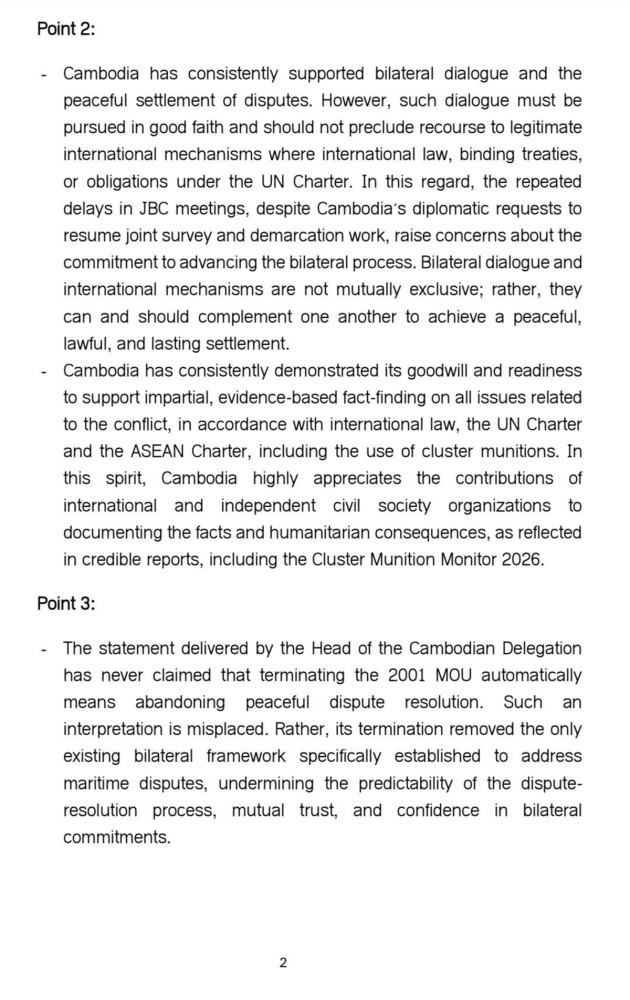
On dispute resolution, the Cambodian delegation reiterated its support for bilateral dialogue and peaceful settlement, stressing that such efforts must be conducted in good faith and do not preclude the use of legitimate international mechanisms. It expressed concern over repeated delays in JBC meetings despite Cambodia’s diplomatic requests to resume joint survey and demarcation work, adding that bilateral dialogue and international mechanisms could complement each other in achieving a peaceful and lasting settlement.
The spokesperson further reaffirmed Cambodia’s readiness to support impartial, evidence-based fact-finding on issues related to the conflict, including the use of cluster munitions, in accordance with international law and the UN and ASEAN charters. The statement also welcomed the contributions of international and independent civil society organisations to documenting the facts and humanitarian consequences, citing the Cluster Munition Monitor 2026 as an example.
Regarding maritime disputes, the spokesperson clarified that Cambodia’s position had never been that terminating the 2001 Memorandum of Understanding automatically meant abandoning peaceful dispute resolution. Rather, the statement said, the termination removed the only existing bilateral framework specifically established to address maritime disputes, undermining predictability, mutual trust and confidence in bilateral commitments.
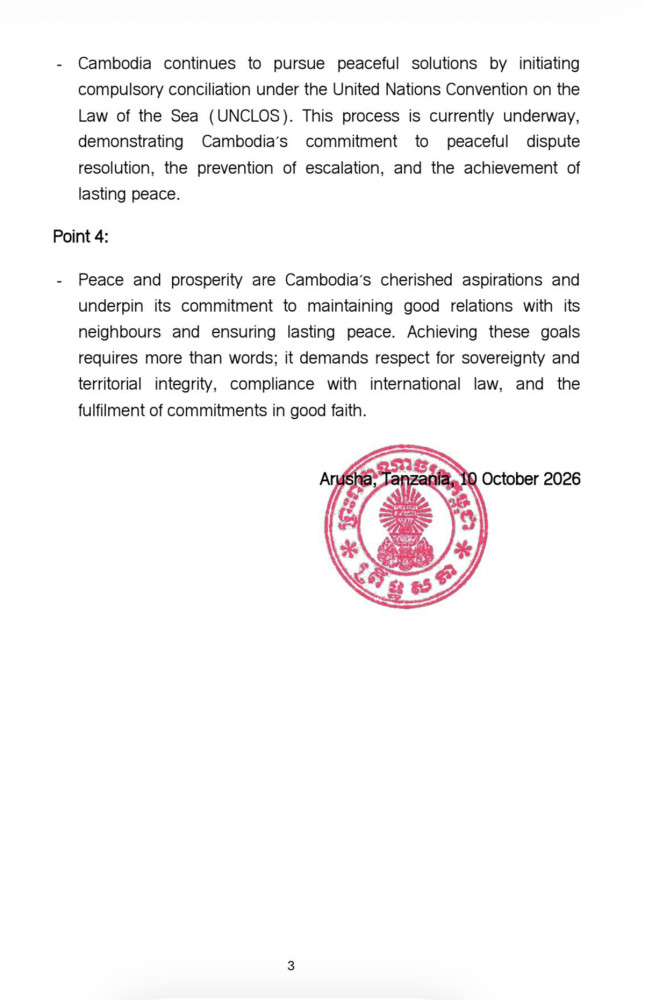
Cambodia continues to pursue a peaceful solution through compulsory conciliation under the United Nations Convention on the Law of the Sea (UNCLOS), a process that the spokesperson said demonstrated the country’s commitment to preventing escalation and achieving lasting peace.
The statement concluded that peace and prosperity remained Cambodia’s aspirations and the foundation of its commitment to good relations with neighbouring countries. It stressed that achieving lasting peace required respect for sovereignty and territorial integrity, compliance with international law, and the fulfilment of commitments in good faith.

By C. Nika