KH
KH  FR
FR  AR
AR CN
CNInformation Minister: Maps, Treaties and Evidence Show An Seh Area Is Cambodian Territory
AKP Phnom Penh, August 29, 2026 -- Cambodia has reaffirmed that the location where Thai Prime Minister Anutin Charnvirakul stood during his visit to the An Seh area on Aug. 23, 2026, is situated within Cambodian territory, stressing that sovereignty cannot be determined by a photograph alone.
According to a Facebook message on Aug. 29 by H.E. Neth Pheaktra, Minister of Information of Cambodia, the photograph of the Thai Prime Minister standing in the An Seh area may demonstrate the presence of a senior Thai official at the location, but it cannot determine territorial sovereignty.
The full message reads as follows:
“The Location Where the Thai Prime Minister Stood Is in Cambodian Territory: Maps, Treaties and Evidence Make This Clear
The photograph of Thai Prime Minister Anutin Charnvirakul standing in the An Seh area on 23 August 2026 may be used to show the presence of a senior Thai official at that location. However, a photograph alone cannot determine sovereignty.
So, on what basis can it be established that the location where the Thai Prime Minister stood is Cambodian territory? The answer lies in the body of internationally recognized documents relied upon by Cambodia, including conventions, treaties and maps, which clearly indicate that the location where Prime Minister Anutin stood is in the An Seh area, Choam Ksan District, Preah Vihear Province, within the territory of the Kingdom of Cambodia.
Therefore, the issue is not whether Mr. Anutin was physically able to reach that location. The issue is that the Prime Minister of one country entered a location situated within Cambodia’s sovereignty and territorial integrity without authorization from the sovereign State. This is why Cambodia has strongly protested what it considers to be an unlawful act.
The Cambodia–Thailand boundary was not established on 23 August 2026 by the mere presence of the Thai Prime Minister at that location, as though his presence could stamp the area as Thai territory. Nor can the presence of Thai military forces stationed there determine sovereignty.
The legal foundations relied upon by Cambodia in addressing the border issue derive from the Franco-Siamese Convention of 1904, the Franco-Siamese Treaty of 1907, the work of the Franco-Siamese boundary commissions, the 1:200,000-scale maps associated with that delimitation process, and other relevant boundary documents.
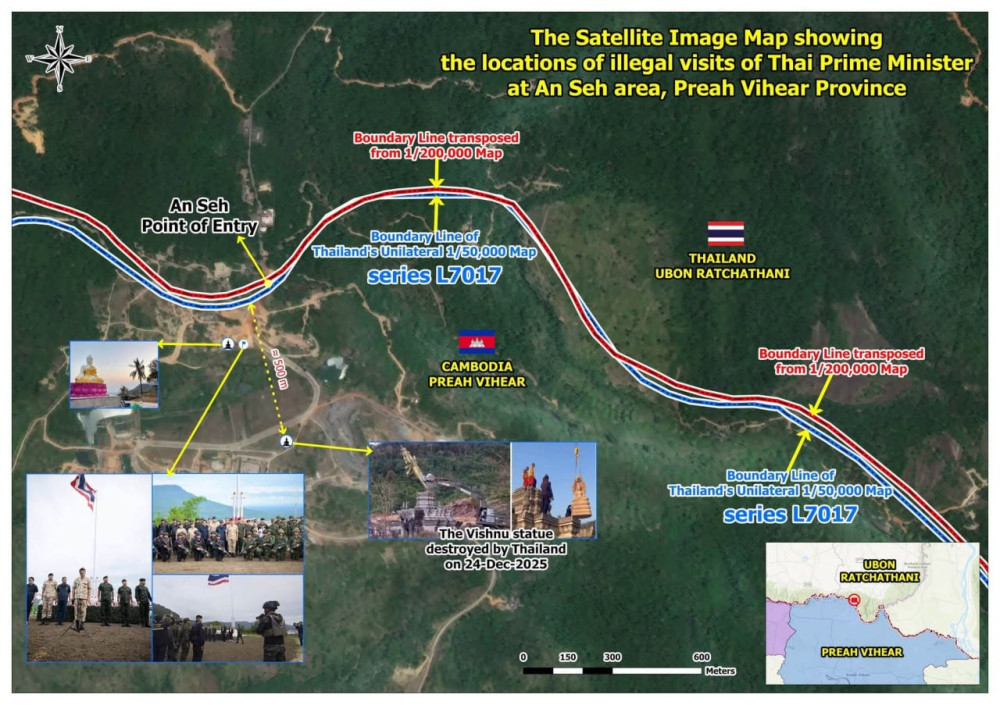
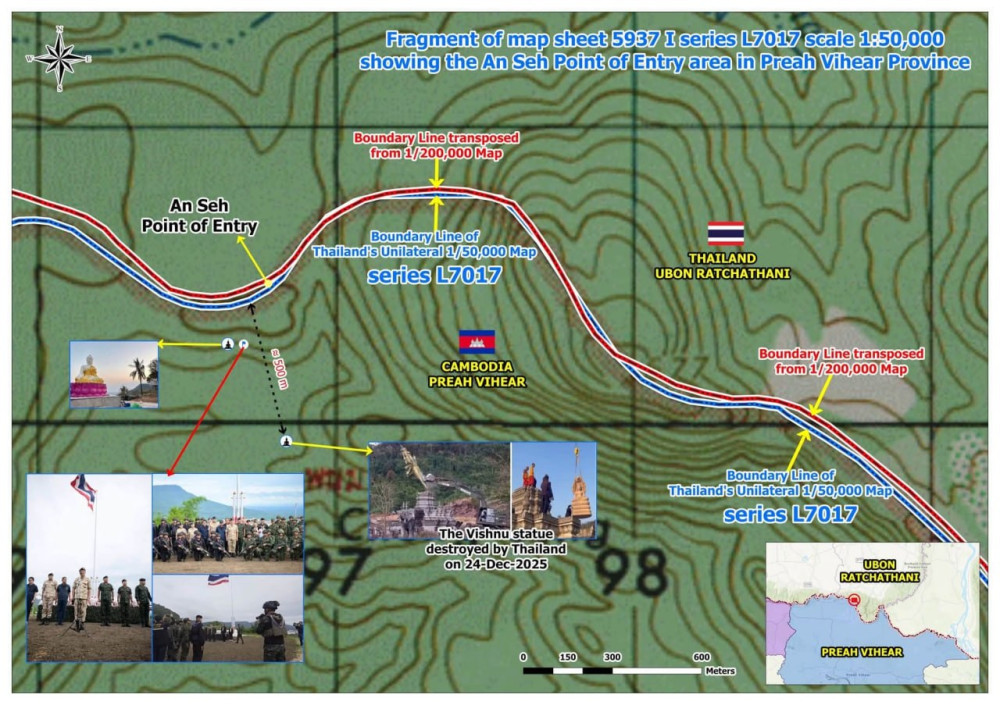
What is particularly significant is that even Thailand’s Series L7017 map at a scale of 1:50,000—which was produced and used unilaterally by Thailand and which Cambodia does not recognize as a legal basis for determining the boundary—also depicts the location identified as the site visited by the Thai Prime Minister on the Cambodian side of the line shown on that map.
When the boundary line relied upon by Cambodia from the 1:200,000-scale map is compared with the L7017 map and with the actual location marked on the satellite imagery, the location is shown on the Cambodian side of both lines. The question Thailand must therefore answer is not how the Thai Prime Minister managed to reach that location, but whether there exists any map, treaty or legal basis demonstrating that the site lies under Thai sovereignty.
If Thailand claims that the location is Thai territory, it must present the legal basis supporting that claim. A bare assertion without legal foundation cannot create sovereignty, nor can an unlawful occupation of Cambodian territory become lawful simply because the same claim is repeated again and again. The fact that a senior official of one country can physically stand at a particular location does not mean that the location belongs to that country. A clear distinction must be drawn between unlawful occupation and lawful sovereign title.
If there is a disagreement, it should be addressed through the Joint Boundary Commission (JBC), not by using military presence to determine the boundary or alter the status quo. Thailand has repeatedly stated that containers and barbed wire do not constitute a boundary line, that Prime Minister Anutin’s unauthorized entry into the An Seh area was not an act of boundary demarcation, and that existing land-border issues should be resolved through the JBC mechanism.
Cambodia and Thailand already have established mechanisms for addressing land-border issues. The 2000 Memorandum of Understanding on the Survey and Demarcation of the Land Boundary, together with the JBC mechanism, provides the framework for both sides to work on boundary matters. If Thailand is genuinely committed to resolving these issues through the JBC, as it has repeatedly stated, that commitment should be demonstrated through concrete action. Thailand should show good faith and sincerity by accepting Cambodia’s JBC proposals to convene meetings, which Cambodia says have been made no fewer than nine times, in accordance with Point 3 of the Joint Statement of 27 December 2025. Yet, up to the present, Thailand has continued to delay those meetings.
The Joint Statement of 27 December 2025 also made clear that arrangements made under that statement were without prejudice to the demarcation and international boundary between the two countries, while assigning the JBC to continue the survey and demarcation process.
Cambodia’s protest is also legally significant because it places on record, in unequivocal terms, that Cambodia does not consent to, recognize, or authorize Thailand’s presence to be interpreted later as evidence that Cambodia accepted the situation. Cambodia has consistently maintained that it does not recognize any alteration of the boundary through the use of force.
The location where Mr. Anutin stood must therefore be assessed by reference to maps and boundary documents, not by flags or military presence. Effective control on the ground is not the same as legal sovereignty, and a situation created unilaterally cannot replace an agreed boundary-demarcation process.
If Thailand claims that the location where Mr. Anutin stood is Thai territory, the answer cannot be found in photographs of the Prime Minister, national flags, containers or troops. The answer must rest on a verifiable legal basis, maps and boundary documents. The planting of flags, deployment of military forces, or unilateral alteration of the status quo through construction or other activities cannot change legal sovereignty. Rather, from Cambodia’s perspective, such acts constitute clear evidence of encroachment upon Cambodian territory.”
AKP