KH
KH  FR
FR  AR
AR CN
CNCambodia Rejects Thailand’s Registration of Border Temples as Ancient Monuments
AKP Phnom Penh, May 13, 2026 --
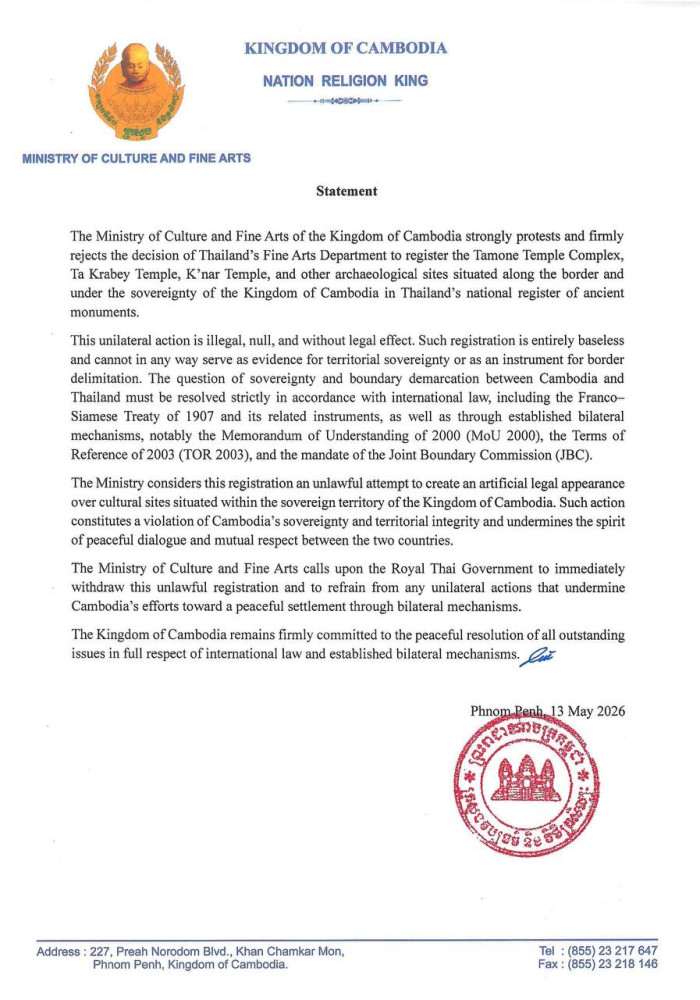
Cambodia’s Ministry of Culture and Fine Arts has strongly protested and firmly rejected Thailand’s decision to register several temple complexes and archaeological sites located within Cambodian territory in Thailand’s national register of ancient monuments.
In a statement issued on May 13, the Ministry said the registration by Thailand’s Fine Arts Department includes the Tamone Temple Complex, Ta Krabey Temple, K’nar Temple, and other archaeological sites situated along the Cambodia-Thailand border under the sovereignty of the Kingdom of Cambodia.
The Ministry described the unilateral action as “illegal, null, and without legal effect,” stressing that such registration cannot serve as evidence of territorial sovereignty or be used as an instrument for border delimitation.
According to the statement, issues relating to sovereignty and boundary demarcation between Cambodia and Thailand must be resolved in accordance with international law, including the 1907 Franco-Siamese Treaty and related instruments, as well as through existing bilateral mechanisms such as the 2000 Memorandum of Understanding (MoU 2000), the 2003 Terms of Reference (TOR 2003), and the Joint Boundary Commission (JBC).
The Ministry of Culture and Fine Arts stated that Thailand’s move represents an unlawful attempt to create an artificial legal appearance over cultural sites located within Cambodian sovereign territory. It added that the action violates Cambodia’s sovereignty and territorial integrity and undermines the spirit of peaceful dialogue and mutual respect between the two neighbouring countries.
Cambodia called upon the Royal Thai Government to immediately withdraw the registration and refrain from taking further unilateral actions that could affect efforts toward a peaceful settlement through bilateral mechanisms.
The Ministry reaffirmed Cambodia’s commitment to resolving all outstanding issues peacefully and in full accordance with international law and established bilateral mechanisms.
By C. Nika